Ballroom is a paired skating style that I've become familiar with quite recently. It requires you to skate with two or more skaters, and when done well, will likely shine a light on your smooth, slick side.
What is Ballroom Skating?
Ballroom skating is a structured, partner based roller skating style that borrows heavily from traditional ballroom dancing styles. It blends smooth gliding sequences, specific synchronised footwork, flowing rotational patterns, and musical timing as way of expressing an elegant conversation between two skaters - usually a male and female pair, but certainly not exclusively. The ballroom pairs decide.
Unlike freeform partner skating, ballroom skating operates from a recognisable framework of steps and sequences, giving it a distinctive look and rhythm that feels intentional, refined, and deeply connected to the slow music set. With ballroom, one skater will play the role of the lead, while the other follows.
At its heart, ballroom skating is about beautiful synchronised smooth or bouyant movements between two or more skaters — not just skating in connection with one another, but moving gracefully together in well timed, and creative ways to soulful sounds [as displayed in the video clip taken during a recent London Ballroom Skating event]. Anybody can get involved in this style, but it's especially good for those who appreciate skating to slow jam — including older skaters who are ready to throw down in the silkiest of ways!
The Smooth St. Louis Influence
Much of modern ballroom skating draws influence from the St. Louis [STL] smooth ballroom style in the United States. This style is characterised by long, continuous lines, effortless looking transitions, and a strong emphasis on gliding moves, rather than sharp, percussive movement. Skaters can appear to float, as they use their roller skate edges, a series of push/pull movememts and controlled rotations to move seamlessly across the floor.
This smooth flow became the foundation for ballroom skating as it spread beyond the US, inspiring skaters elsewhere to adapt it to their own environments and taste.
➡️ Watch Video: STL ballroom skaters
Keeping it Smooth on the Rough London Streets
London ballroom skating has taken that smooth St. Louis influence and adapts it for very different conditions. Our skating environments are often outdoors, uneven, and far less forgiving than polished rink floors of St. Louis. As a result, the London style developed with slightly tighter steps, more grounded weight placement, and an emphasis on stability without losing its elegance.
The outcome is a ballroom style that can be performed in our often heavier hockey boot conversions on rough terrain, yet still feel fluid and graceful, but with a robustness that allows it to work on rougher terrain — car parks, streets, and outdoor event spaces. The conditions, at times, require us to push, pull and engage our edges a little more at times, but we make it work. It’s still ballroom skating, just shaped a little by our rougher outdoor London surfaces.
➡️ Watch Video: Myself & Andrew ballroom skating
➡️ Watch Video: Myself & Michael [with Michael injured & off skates] ballroom skating
Ballroom Skating vs Partner Skating
One of the most common misconceptions is that ballroom skating and partner skating are the same thing. While they overlap, they operate quite differently in practise.
In partner skating, the framework is loose. You can quite literally do almost any skate move with a partner, so long as you continue to reconnect periodically. The emphasis is on interaction between the pairs rather than utilising a series of specific steps.
Ballroom skating on the other hand, has clear baseline movements that everything flows from. There is structure and sequencing, with a loose but recognisable order to how steps link up. You’re not just skating together — you’re skating through a shared language of movement, within a recognisable foundational framework.
This is the loose structure that gives ballroom skating its unmistakable look.
The Big Leap: Notting Hill Carnival
My own journey into ballroom skating really began last year at the Notting Hill Carnival event. That was where I met Nikki and Andrew, who introduced me to their ballroom skating style, specifically for the summer event.
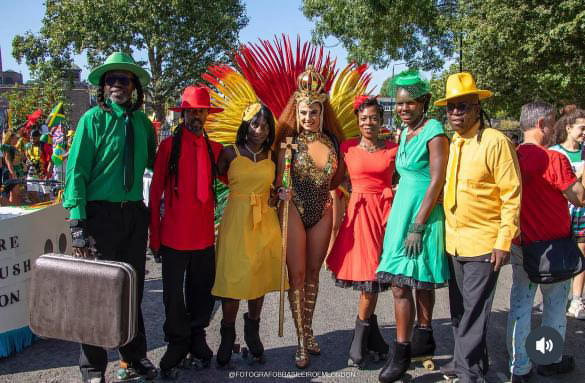
Learning ballroom for the carnival opened my eyes to how intentional and expressive this style of skating could be. Since then, I’ve continued to develop my understanding and practise of ballroom skating under their guidance, gradually building confidence in both the steps and different partnership dynamics.
➡️ Watch Video: Ballroom skating at the Nottinghill Carnival event [of Nikki & Andrew, Ken & Jules, Micheal & myself]
My First Attempts
Before that, I’d had brief but important introductions to ballroom skating. About a year earlier, I took part in a couple of workshops with Alan Higgibod. This was my first exposure to ballroom fundamentals.
➡️ Watch Video: Ballroom skating workshop with Alan
Later, during the Rendezvous Paris skate festival last June, I had a one-to-one experience with a well known ballroom skating OG Leo [1wheel] White [@leowhite1wheel]. That impromptu moment helped me to connect the dots between the basic framework and the key attributes of skating as a ballroom pair. It reaffirmed just how deep this style really goes. Leo— a dedicated ballroom teacher — was so very generous with his time, especially considering that it was the first time we had met.
The London Ballroom Skating Community
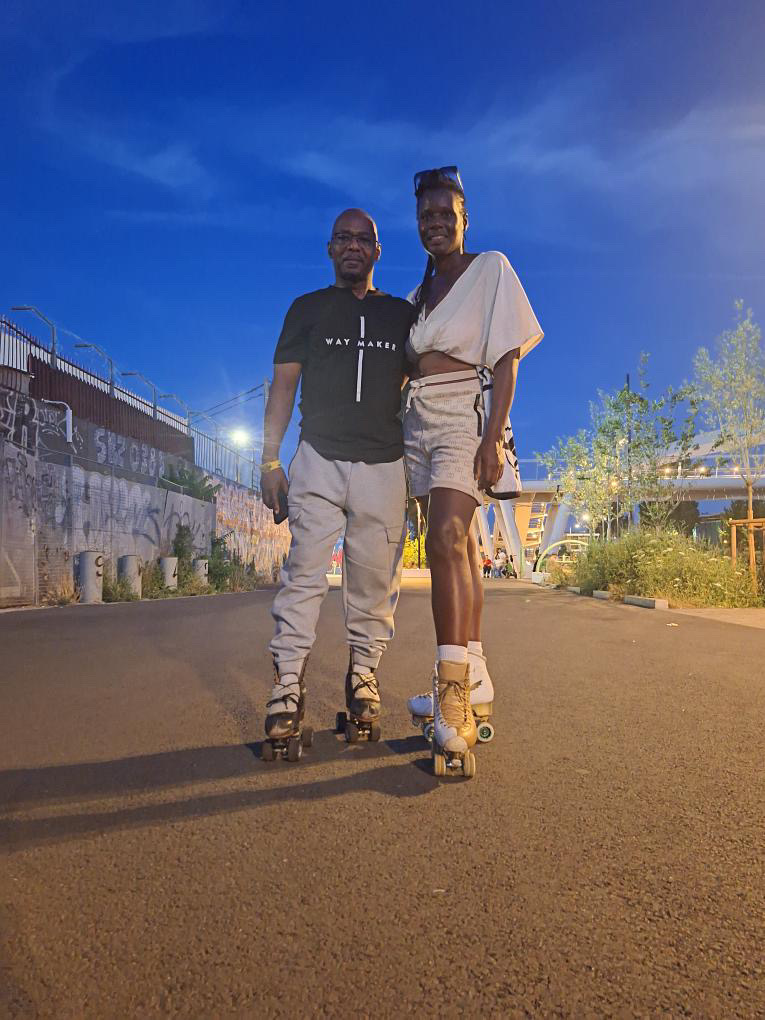
Over the past two years, ballroom skating has really begun to take a hold within the London skating community. What was once a niche interest is now something that we're steadily seeing being done with some regularly, with the majority of skaters at least giving it a go.
Whether through workshops, social skate meets, or bigger events, ballroom skating is now becoming part of the shared vocabulary within our London skate culture — and it’s been exciting to watch our collective curiosity turn into genuine engagement.
"We're now seeing increasing numbers of skaters dedicating large amounts of focus on mastering this beautiful skating style, with a strong ballroom community slowly emerging."
~Kelly
[Skate Base London]
Is ballroom skating suitable for beginners?
While ballroom skating is beautiful and rewarding, it’s not suitable for an absolute beginner.
To get the best out of ballroom, a skater needs a solid foundation in balance, coordination, and timing. More specifically, it helps if you're able to:
-
Perform a T-stop confidently on both sides
-
Shuffle backwards with control (this appears multiple times as you transition through various steps)
-
Execute a single spin, as spinning frequently appears between most [but not all] ballroom skating pairs
Without a solid foundation in the very basics, ballroom skating can feel like an uphill struggle rather than the enjoyable experience it should be. But once those basic fundamentals are in place, ballroom skating becomes an incredibly satisfying next step — offering a great structure from which to operate out of, creating a beautifully creative connection between one or more skaters, while offering up a refreshing new way to experience movement on skates. It can — like any other skating style — up your skate skill game as you improve control of your turns, backwards steps, timing, footwork control and spins.
Ballroom skating isn’t just about learning a series of pre-determined steps. It’s about learning how to move alongside and with someone else in lovely synchronised ways. It's all about elegance and grace. Its a lovely style that's shaped by the soulful slow jams that this style is so often skated to— with a backdrop of historical musical influences, black culture, and a close nit diverse community. And in London, it’s only just getting started.
Find out more about Nikki and Andrews workshops and course:
Kelly
Cranial Osteopath | Wellbeing Coach | Roller Skate Instructor
🗯️ Have you had a go at ballroom skating yet? Share your thoughts on this skating style in the comments below, or leave a quick emoji response.