I’ve known Roland since 2022, when he first took photos of my son and me on roller skates.
The skate scene was much quieter back then, and Roland was just beginning his skate photography project.
Since then, he’s photographed me on several occasions — first at the skate park and at my home with my son, later in a photography studio, more recently during rehearsals for an upcoming three-day performance at The Posh Club, as well as sporadically during a variety of meets and events. Roland has also photographed my mum in her skates — at the age of 70. Come to think of it, Roland has photographed most of the leading figures and members of the skate community.
When I first met Roland, he was certain that skating wasn’t for him. But when I saw him again around a year later, he was in a shiny new pair of skates, drilling his foundation moves with a dedicated focus. Since then, he’s become just as obsessed with skating as the rest of us — it’s been beautiful to watch his passion for skating blossom.
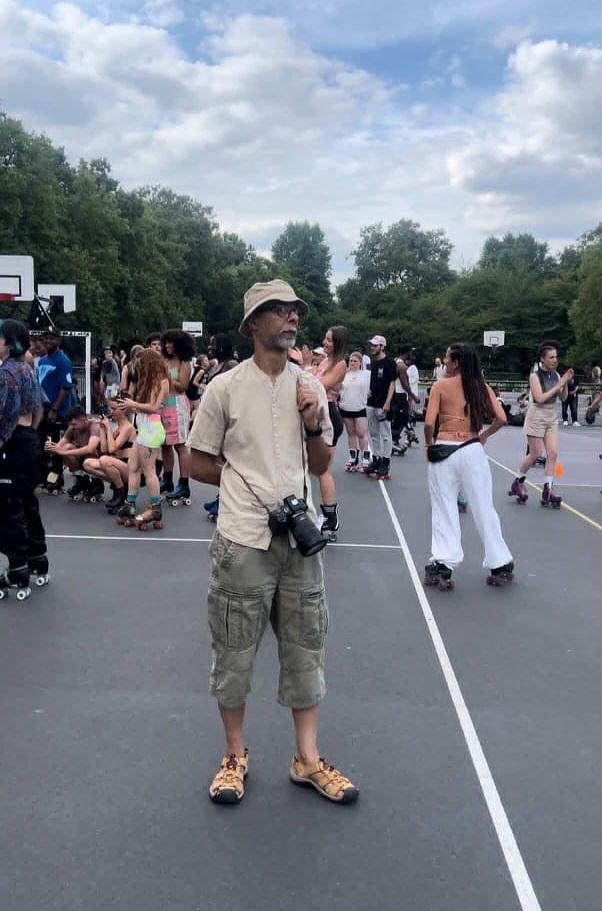
"Roller skating has a unique ability to kind of charm and disarm people. They just really observe and and get pulled into the moment through curiosity.
Skating's not like anything out there."
~Roland Ramanan
7 Questions
Q.1 What is your background?
"Uh, well, my background first of all, is in special educational needs.
I was head of an SCN service in Tower Hamlets in East London for many, many years, so my background is in special ed.
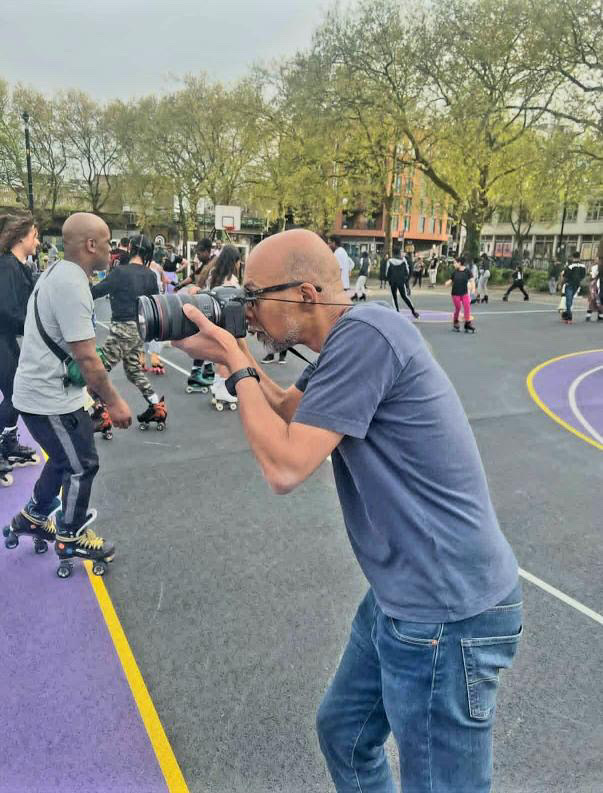
I got into photography around 2012, something like that, and I did a big project, which became a book, a social documentary project about vulnerable people in East London. Then the the pandemic happened. I was walking around my local park, Victoria Park, and I saw these people roller skating, um, dancing on roller skates, and I'd never seen anything like it. Roller skating was not on my radar at all, not something I was aware of, and I thought, I'll just take a couple of pictures.
I've always had a creative life in terms of being in interested in art and music, I play the trumpet and things like that and I think at one time, I was into painting, but I found it very frustrating because it was very difficult without any training. I just got into to street photography, I knew someone who was a street photographer, and that I got really into walking around the streets.
One of the things I always liked about photography early on was engaging with people. I mean, I'm normally quite a shy person, but it was nice, it was a different way to engage with people. When you have the camera, it gives you permission to talk to people in a different way and engage with them with maybe more confidence in the sense. I enjoyed telling stories and kind of being on the on the inside of stories. That's what kind of fascinated me.
So I thought I would just take a few pictures while the lockdown was happening. I thought, you know, lockdown will be finished soon.
I'll take a few pictures, and that will be that, and then four years later.
Here I am."
Q.2 What has interested you most about photographing skaters?
"Um, what I what I found was, uh, a whole culture behind it. It was much more than just people doing it to kind of have fun. So as soon as I started to talk to people and find out a bit more about, you know, why they were doing this, a whole other world opened up. And, you know, it was at the time when, you know, lots of information was available on Instagram, so I could follow people and I could see where they came from and what they were influenced by and the culture from The States and the culture from this country and the dance culture. So it was a whole culture that was opening up in front of me, and that's what interested me, that's what kept me involved. I thought, oh, this could, have legs as a as a project because it has that kind of depth behind it. So then I started to do interviews with people really just for my own sake just to find out. They started to give me background about the skate culture and that became really interesting."
Q.3 What did you find that you didn't expect to find?
"Um, I think it was, uh, it was an aspect of black culture that I wasn't really familiar with, but it's linked to other aspects of black culture.
So, you know, I could find out about the role of roller skating, let's say for example, you know, in The United States, where it was quite, uh, pivotal in terms of, who had access to leisure facilities and who didn't.
So it was kind of embedded in lots of things in terms of civil rights, certainly in The United States. It was linked to hip hop culture, dance culture, But, then it also had this, I don't know, this kind of interesting aspirational aspect to it. This kind of excitement that was driven by, you know, Black exhibitionism and kind of wanting to go one step further. It was exciting, but also it was accessible. So, yeah, all of that was very interesting."
➡️ Watch Video: Roland Ramanan Photography - Roller Skaters
Q.4 As you became more involved what did you notice?
"There are two or three things. The first one, the culture was changing because it was at a pivotal point, but also I was changing in terms of what I knew. So, you know, the more you know, then the more you see, the more you can you can photograph.
I started skating myself which gave me a better understanding of what people were doing and kind of how to photograph it. But I also wanted to show, uh, more behind the scenes. Well show people who the skaters were rather than just what they did. So that means going deeper and getting, you know, kind of behind the scenes. But also, suddenly there were a lot more people skating. You know, I was just starting at that pivotal point where it kind of really exploded. In a way a little bit less underground, because there were a lot more people who had a good level of skating leading to lots more kind of community and events and things which was, which was wonderful to see.
And then you had Flippers you know, like club roller rink, a dream which was about to be realised. So it was a very interesting part of the story because, you know, at the time, some people thought Flippers kind of galvanised the scene and was the answer to everything. It turned out not to be the case at all. It turned out to be almost irrelevant because the the scene was then self sustaining from the ground up community level. Flippers closed and skating is still continue to expand. So that was really, uh, really interesting.
And, you know, the other aspect of my photography, I was thinking about the skate scene in a different way. I wanted to show other aspects of the beauty of skating. So hence doing the black and white portraits, taking people out of the context of the car park or the rink and kind of just showing the beauty of them and what they do, inspired by photographs of ballet dancers, for example, just, you know, it's a different kind of different way of showing different aspects."
Q.5 When when I first met you, I encouraged you to have a go, and you were absolutely adamant that it was not something that you would ever participate in. What happened Roland?
"I mean, I'd not considered skating before, and I don't have a sporty background at all. So I've got no background in doing anything on on wheels apart from, maybe going on a on a bike and even that, you know, not very much. So, yeah, at my age, I was 56 of the time. It was a bit scary.
I remember you were encouraging me. And, uh, Jamie [who took the first 2 photo's on this page] was really, really, REALLY encouraging me, telling me, you know, just try. You gotta try. I'm always very reluctant to try new things. Then once I've started, I kind of stick with it as much as possible. I was not a natural at all. It was very scary, very intimidating. I don't know, falls in in my kitchen where my neck would just ache for ages after, you know.
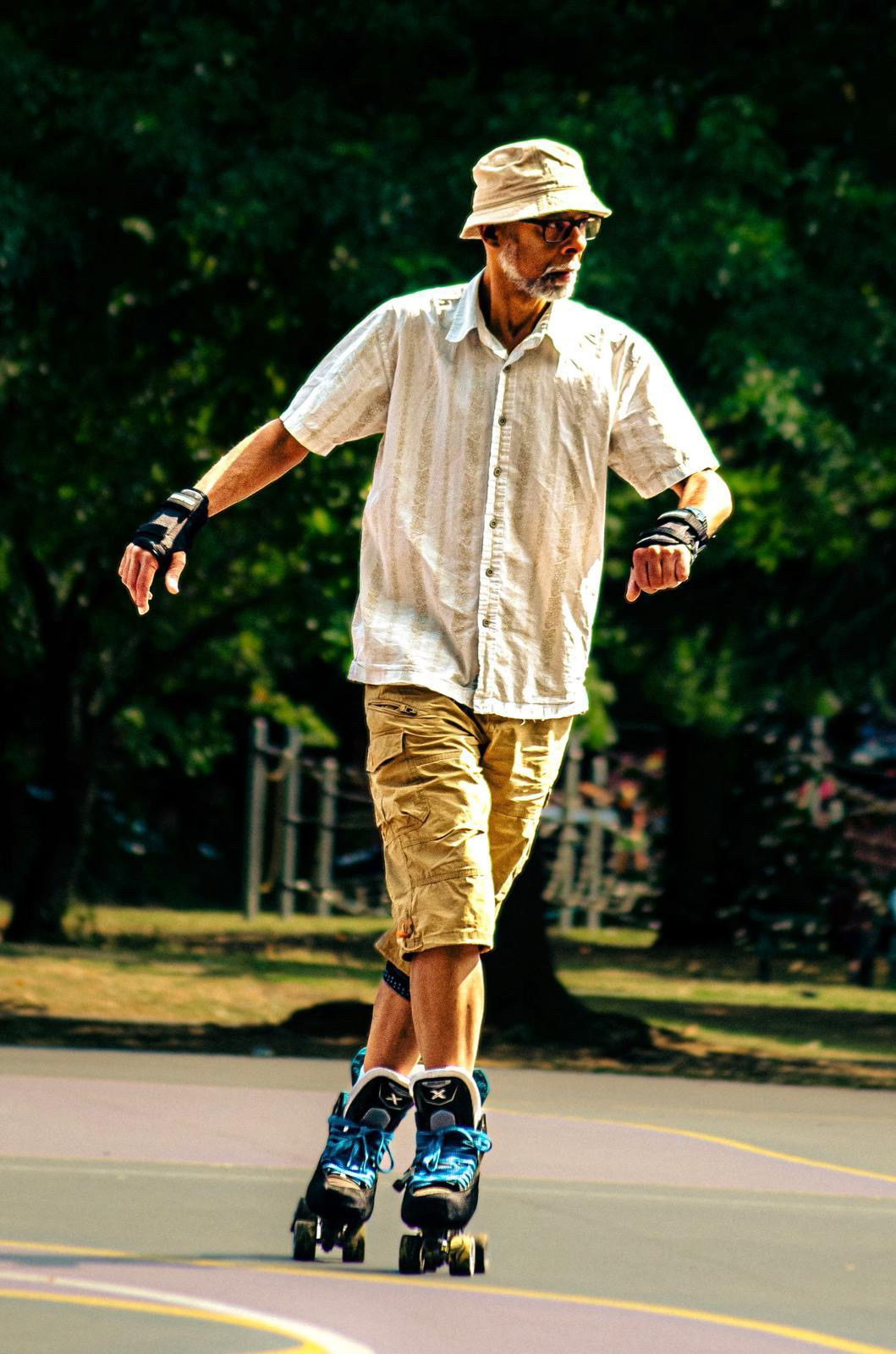
Um, but I had time, so you know, it came at a moment where I had time. I could do a little bit every day. It was scary, and there there were times when I was out in Bethnal Green every day, just kind of drilling. I'm watching Dirty Deborah videos and trying to analyse what it was, it was painful, but I did get better. So I did need that persistence.
But, I've become really obsessed. And as you know, roller skating is strangely addictive. It's fun. It's a nice feeling to roll and to move on on the wheels. And you've got a lot of people around you that you can see are doing different things and having fun with it. It's very flexible. You can learn dance moves, and footwork if you want to do that, or you can just, enjoy kind of skating around the park if you if you want. All those little things that you can add on are very inviting, very compelling.
There are all these little kind of incremental things that are calling you.
To try. There are so many different things that you can you know, that you can try that are within your grasp. So I think that's what it is.
Skating's not like anything out there. You can do it on your own.
You can do it holding hands. You can do it in a group.
So it has all that kind of flexibility."
Q.6 What is it about skating that you think is so compelling?
"I think, skating touches on many things. It's almost like going through a portal into another world, and that made me think of themes of Afro-futurism, which is imagining, a better way of being for black people. And I think, skating kind of exemplifies that somehow, that people want to be the best of themselves in this kind of culture.
Obviously, skating is for everyone, it's very inclusive, but one of the things I picked up on is that black people tend to be the drivers of the of the culture in terms of kind of pushing the boundaries and pushing forward. Also, skaters have a wonderfully positive mindset in so many ways. Whether we are using it to calm down and just be in the moment and to reflect, or using it to push our own boundaries and creativity.
Skaters often have a very positive mindset. I've seen that, or it encourages people to have a more positive mindset because you know, you have to really stick with it and and progress. So, it's just wonderful. Skating is a joy and something I found which completely unexpected. I'm not sure if I hadn't been doing the project, I'm not sure I would have stuck with it! I owed it to the Skate community to give it a good go. Because, you know, sitting with skaters and being with skaters hour after hour, I knew I had to do more than that. It was kind of like, I felt obliged. It was guilt. At first. And then I enjoyed it.
So in interviewing lots of the skaters, one thing that came out was the fact that, as as black people, sometimes they could be perceived as, uh, you know, in certain ways or as a threat, but the being on roller skates was really disarming. When young children saw them, you know, they we're kind of delighted, when older people saw them, they thought about their childhood. Roller skating has a unique ability to kind of charm and disarm people. They just really observe and and get pulled into the moment through curiosity. I mean, it's amazing, you know."
Q.7 What's coming up next for you?
"What's next is pulling together the material I have into a book, which is my own take on the skate culture. But also I want to include some of the other artistic aspects of skate culture. As you know, skaters are very creative. Many of them are artists and videographers.
And I wanted to reflect that somehow. I've got some some artwork from skaters. I've got poetry from skaters. I've got some old, some vintage, photographs. I've got some screen grabs from iPhones. I've just about finished the design with a a brilliant designer I'm working with, then next week to try and see if I can publish a book. It's called Free Rolling. So that depends on a lot of things. So first, I have to see if, I can find a publisher, the person who published my first book might publish it. So, yeah, I'll keep everyone, keep everyone posted.

I think I'll always have one foot in skating photography, where people ask me to do things, it's kind of lovely to do. I've got a couple of other ideas. Like, I'm toying with the idea of photographing every permanent skating rink in The UK. So I'm that's something I might do, you know, other aspects might present itself. But I'll probably in terms of a main project, I'll probably move on to other things, but we'll see.
But, yeah, first I need to get this book out. I'm hoping that skaters are really gonna help me to promote it.
➡️ Listen/share: Roland's audio [via YouTube]
➡️ Follow: @rolandramanan_skaters on instagram.
➡️ Previous interview: 7 Questions With Kat
➡️ Listen to the 7 Q's series on Spotify or Apple Podcast
Kelly
Cranial Osteopath | Wellbeing Coach | Roller Skate Instructor
🗯️ What have you learned from Roland's skate photography journey? Was there anything that really struck you? Share them in the comments below or, leave us a lil emoji response.